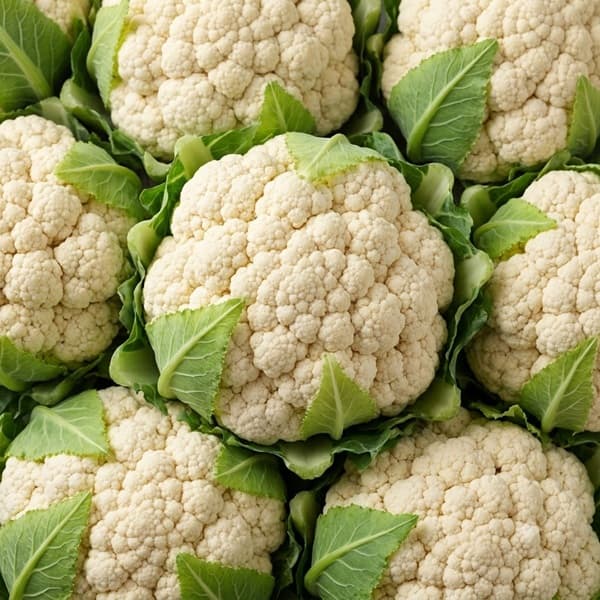
Cauliflower is a vegetable belonging to the Brassicaceae family, widely cultivated in Vietnam and many regions with cool or temperate climates. The main edible part is the immature flower head, typically white to creamy white, with a firm texture and a surface composed of numerous small branching florets. Cauliflower has a mild, delicate flavor and is commonly used fresh in a variety of dishes.
Distinctive Characteristics
The flower head is round or slightly flattened, consisting of numerous small florets forming a compact cluster surrounded by green leaves.
The head ranges from white to creamy white, with a relatively uniform surface. When in good condition, the florets remain tightly closed without separation or abnormal discoloration.
The stem and stalk are white to pale green and relatively firm, and can be used together with the flower head after preparation.
Good-quality cauliflower has a dry, firm surface, natural coloration, fresh leaves, and no signs of bruising, waterlogging, pest damage, or mold.
The size, color, and firmness of the flower head may vary depending on the variety, growing conditions, and harvesting stage.
Flavor & Texture
Cauliflower has a mild, delicate flavor with a subtle natural sweetness and the characteristic aroma of Brassica vegetables. When fresh, the florets are firm with a slight crispness. When cooked, they become softer while retaining their firmness when prepared for an appropriate amount of time.
Uses & Applications
Boiled or steamed and served directly or with dipping sauces.
Stir-fried with meat, seafood, mushrooms, or other vegetables.
Roasted or pan-seared to develop aroma while retaining the firmness of the florets.
Used in soups, broths, and stews.
Used as an ingredient in salads and mixed vegetable dishes.
Used in fried or battered dishes, or prepared with cheese and various sauces.
Nutritionally, cauliflower provides dietary fiber, vitamin C, vitamin K, folate, vitamin B6, potassium, and various naturally occurring plant compounds. Nutritional values may vary depending on the variety, maturity, and storage conditions.