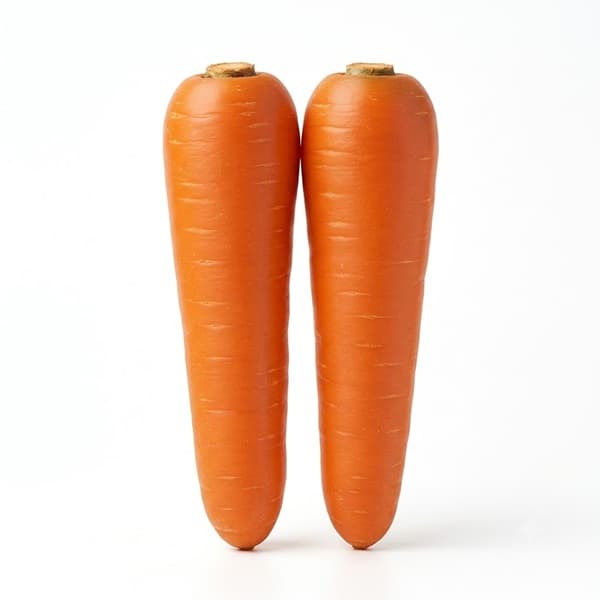
Orange Carrot - Da Lat is a root vegetable belonging to the Apiaceae family, widely cultivated in Da Lat, Lam Dong Province, Vietnam. The carrot grows underground and typically has an elongated cylindrical shape, with a slightly broad upper end that tapers toward the tip. Both the skin and flesh have a characteristic orange color. The surface is relatively smooth, while the flesh is firm, crisp and juicy.
Distinctive Characteristics
The root has an elongated cylindrical shape, with ends that are usually slightly pointed or rounded, and varies in size and shape.
Both the outer skin and inner flesh have a natural orange color, generally showing relatively uniform coloration throughout.
The surface is relatively smooth and may feature natural longitudinal lines or small secondary roots.
The flesh is firm, crisp and juicy, without signs of excessive softness, bruising or spoilage.
Fresh carrots of good quality have natural coloration, intact roots and no signs of mold, sliminess or unusual odors.
Carrots are generally supplied whole and can be used whole, peeled, sliced, diced, julienned or shaped according to the intended preparation.
Root size, shape and color may vary depending on the variety, growing conditions and harvesting time.
Flavor & Texture
Orange carrots have a naturally mild sweetness and a characteristic delicate vegetable aroma. When eaten raw, they are crisp, juicy and mildly sweet. When cooked, the flesh gradually softens and develops a more pronounced sweetness while retaining some firmness depending on the cooking method and duration.
Uses and Applications
Orange carrots are suitable for a wide range of culinary applications:
Stir-frying: sliced, julienned or diced and stir-fried with meat, seafood and other vegetables.
Soups & Broths: cut into sections or diced for vegetable soups, pureed soups and broths.
Stewing & Braising: combined with beef, pork, chicken or other vegetables in stewed and braised dishes.
Salads: shredded or thinly sliced, served fresh or combined with other vegetables.
Juices & Smoothies: used as an ingredient in fresh vegetable juices and smoothies.
Pickling: julienned or sliced for sweet-and-sour pickled carrots and mixed pickled vegetables.
Food Garnishing: carved into decorative shapes or sliced to enhance the appearance and color of dishes.
Vegetarian Dishes: combined with mushrooms, tofu and other vegetables in stir-fries, soups and braised dishes.
Preparation: can be used whole, peeled, sliced, cut into sections, diced or julienned depending on the dish.
Orange carrots provide dietary fiber, carbohydrates, vitamin A in the form of beta-carotene, vitamin K1, vitamin B6 and minerals such as potassium. Beta-carotene is the natural pigment responsible for the characteristic orange color of carrots. It is converted into vitamin A in the body and contributes to maintaining normal vision and immune function.