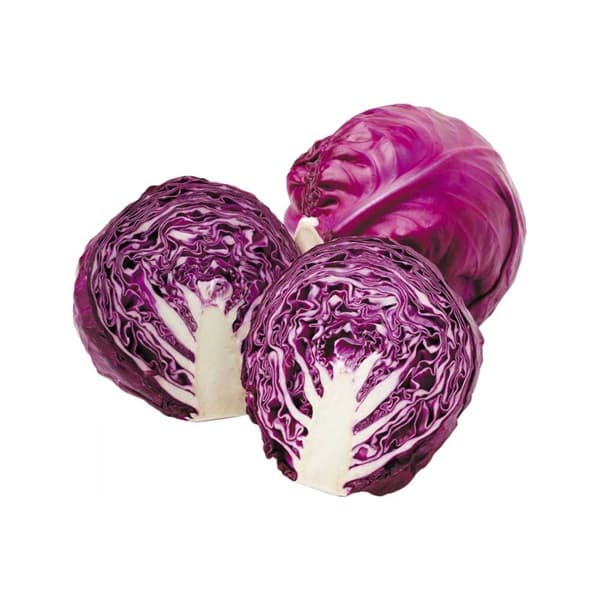
Red Cabbage / Purple Cabbage is a leafy vegetable belonging to the Brassicaceae family. It is widely cultivated in regions with suitable growing conditions, including Vietnam. The plant forms a compact head with tightly layered leaves. The leaves range from reddish-purple to deep purple, with a relatively firm and crisp texture. Red Cabbage has a mild, slightly sweet flavor and is commonly used in salads, mixed dishes, stir-fries, cooked dishes, and food decoration.
Distinctive Characteristics
The cabbage head is round or slightly flattened, with tightly layered leaves forming a relatively firm structure.
The leaves range from reddish-purple and deep purple to purplish-green, depending on the variety and growing conditions.
The leaves are relatively thick, with prominent veins and slightly wavy edges.
Good-quality cabbage generally has a firm head, intact leaves, fresh color, and no signs of bruising, yellowing, decay, or mold.
The leaves can be separated from the head and used whole or sliced and cut according to the intended application.
When sliced or shredded, the leaves retain their characteristic purple color and noticeable crispness.
Head size, compactness, color, and crispness may vary depending on the variety, growing region, season, and harvest timing.
Flavor & Texture
Red Cabbage has a mild, slightly sweet flavor and a fresh leafy aroma. The leaves are firm, crisp, and juicy when eaten raw. When cooked, they gradually become softer while retaining some firmness. Its distinctive purple color adds a strong visual element to a variety of dishes.
Uses & Applications
Salads: shredded or sliced and combined with lettuce, carrots, cucumbers, tomatoes, and other vegetables.
Fresh consumption: served raw with dressings, vinaigrettes, or seasonings.
Mixed dishes & slaws: shredded and combined with meat, seafood, vegetables, and dressings.
Stir-frying: cooked with meat, seafood, mushrooms, eggs, or other vegetables.
Soups & stews: used in soups, vegetable stews, and other cooked dishes.
Pickling: used to make pickled cabbage, fermented vegetables, and other preserved products.
Wraps: used as whole leaves or sliced leaves with meat, vegetables, and other ingredients.
Food decoration: shredded or sliced to add color and visual appeal to salads, dishes, and platters.
Preparation: leaves can be separated, shredded, sliced, or cut according to the intended use.
Nutritionally, Red Cabbage provides water, dietary fiber, vitamin C, vitamin K, folate, vitamin B6, potassium, and manganese, along with naturally occurring plant compounds such as anthocyanins.