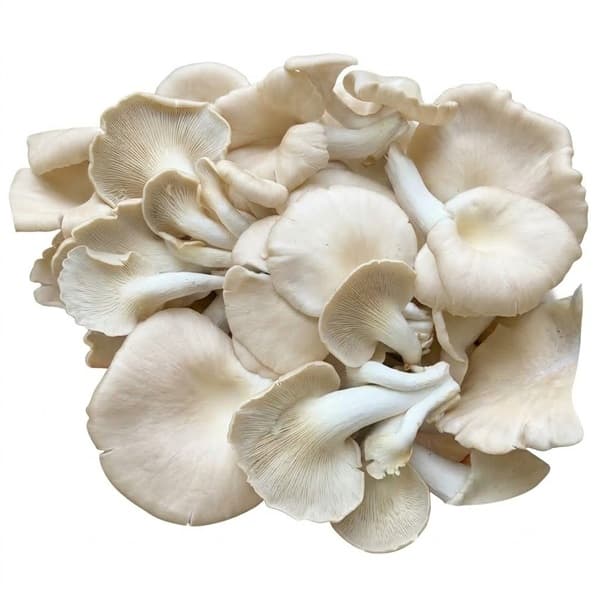
White Oyster Mushroom is an edible mushroom belonging to the genus Pleurotus, family Pleurotaceae. It is characterized by white to creamy-white caps with fan-shaped or shell-like forms, short stems, and a tendency to grow in clusters. White oyster mushrooms are widely cultivated on various organic substrates and are commonly used in food preparation.
Distinctive Characteristics
The caps are white to creamy white, with fan-shaped, shell-like, or slightly rounded forms.
The cap surface is smooth and soft, with thin edges that are often slightly curved.
The mushrooms commonly grow in clusters, with individual caps naturally overlapping one another.
The flesh is white and moderately thick, while the stems are short and relatively firm.
Fresh mushrooms have good elasticity, intact caps, a naturally dry surface, and no signs of sliminess or bruising.
Flavor & Texture
White Oyster Mushrooms have a mild aroma, a delicate sweetness, and natural umami. The flesh is soft and succulent while retaining a slightly chewy and elastic texture; the stems are generally firmer than the caps. When cooked, the mushrooms retain their texture relatively well and readily absorb seasonings.
Uses & Applications
Stir-fried with garlic, vegetables, meat, or other ingredients.
Used in soups, broths, and hot pots.
Grilled or pan-seared to retain their natural aroma and texture.
Suitable for steamed, braised, or stewed dishes.
Can be fried, battered, or prepared in various mushroom-based dishes.
Can be combined with vegetables and other ingredients in both vegetarian and non-vegetarian dishes.
Nutritionally, White Oyster Mushrooms provide dietary fiber, protein, B vitamins, potassium, phosphorus, and various minerals and naturally occurring bioactive compounds. Nutritional composition may vary depending on the variety, growing substrate, cultivation conditions, and maturity of the mushrooms.