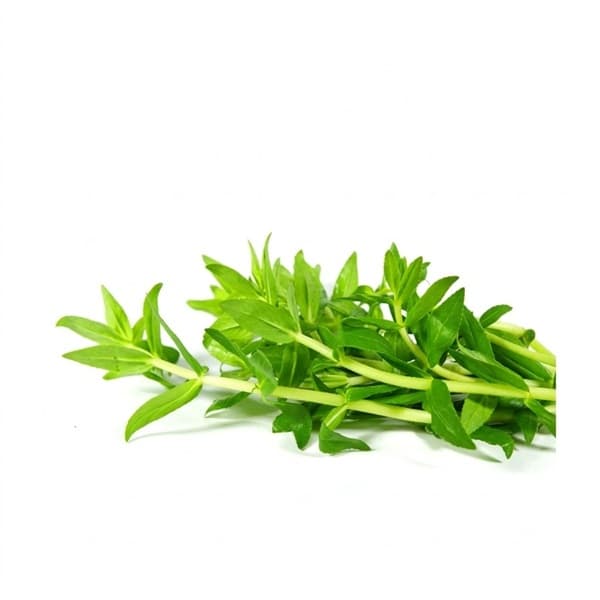
Rice Paddy Herb is an aromatic herb belonging to the Plantaginaceae family, scientifically known as Limnophila aromatica. It is native to Southeast Asia and is widely used in Vietnamese cuisine. The herb commonly grows in moist environments or near water sources and has soft stems, small elongated leaves, and a distinctive aromatic profile.
Distinctive Characteristics
The stems are soft and succulent, growing upright or slightly trailing, with natural branching and a green color.
The leaves are small, elongated, or lance-shaped, growing opposite each other along the stems, with fine serrations that may be visible along the edges.
The leaves contain numerous natural oil glands that produce a distinctive aroma when crushed or cut.
The herb has a natural green color, with soft, succulent stems and leaves that are easy to prepare.
Good-quality rice paddy herb has fresh green leaves, moderately firm stems, and no signs of yellowing, bruising, waterlogging, pest damage, or mold.
Stem and leaf size, as well as aroma intensity, may vary depending on growing conditions, variety, and maturity.
Flavor & Texture
Rice Paddy Herb has a distinctive fresh herbal aroma with mild spiciness. The stems and leaves are soft and juicy, making them suitable for dishes with broths and sauces. When cooked, the herb becomes softer while retaining part of its characteristic aroma.
Uses & Applications
Sour soups: commonly used in Vietnamese sour soups with fish, shrimp, meat, or seafood.
Soups & broth-based dishes: added to soups and other liquid-based dishes for aroma.
Fish dishes: used as an herb in braised, steamed, grilled, or soup-based fish dishes.
Seafood dishes: combined with shrimp, crab, clams, mussels, and other seafood.
Mixed dishes: chopped and combined with other herbs and vegetables.
Food decoration: used whole or chopped to add color and aroma.
Preparation: the leaves and tender stems can be washed and chopped or cut into sections depending on the intended application.
Nutritionally, Rice Paddy Herb provides dietary fiber, vitamin A, vitamin C, some B vitamins, minerals, and various natural aromatic compounds. Nutritional composition may vary depending on growing conditions, maturity, and storage conditions.